

Red Star Tx Book Club: Flipping a Page Into Advocacy

My first experience with the Red Star Tx Book Club came from the zine reading "Building Your Own Solidarity Network." Hosting this reading was brought forward to me and so it happened on a Monday evening at the Ponte Creative Studio & Gallery. The thing is...I've seen these book club announcements before for example, but they came come off "intimidating" so I always wondered if it was "right" for me. Although, from my experience that wasn't the case. Speaking to Amaru and the way this session was facilitated really showed me what this was all about.
The structure, engagement, the conversation and even the act of a continuous thought after the session itself has ended. I didn't go home empty handed when I left home curious and now involving myself in ways that seem fit.
The Red Star Tx Book Club aims to bring forward a call to action and moving that call into motion.
Here is a little more on the book club with Amaru,

For those who may not know, what is Red Star? What is the purpose and mission behind Red Star as Amaru explains "Red Star TX is an organizing home meant for people from all backgrounds to share their causes, such as the fights against SpaceX, Palestinian genocide, police brutality, and food insecurity. Our mission is to unite the broadest masses against the narrowest target of class oppression. I joined on behalf of Half The Sky TX, a working class org for nationally-oppressed women and trans people, and since then Red Star TX has been an incredibly supportive ally."

Now with Red Star it brings forward the Red Star Tx Book Club. What prompted the book club to start and continue to where it is today? "The book club has been around for a few years now, and it started as a way to educate our members on complex political topics. When I joined 2 years ago, we often read long form books and our audience was very broad, ranging from experienced organizers to people reading for fun. I slowly became more active, eventually facilitating a few meetings, and later I inherited the role of host full time. Since then, it's evolved to focus on every day people who are new to organizing and connect with them through mass work. This type of organizing requires us to form close relationships with the masses and fight alongside them, in the process growing their class consciousness and powerful mass movements." It's interesting you say "it's evolved to focus on every day people." Whenever I hear groups wanting to organize it's typically within their own sphere. That sphere/circle being individuals who went to school, individuals who listen not act, individuals who join in to say they did. Not reaching out to the "every day people" to connect them with this information than someone who has.
Especially when it came down to see the amount of people coming into book club night. After 6pm, after their shifts. People I've met before (very few) and new people - who even in consideration may not have read the zine, but were interested. What got to me was the involvement in conversations and questions from just about the whole table. Individuals sharing their personal experiences as examples.
I look forward to being there again.
Book Clubs can be hmmm "intimidating" especially for certain topics/themes in hand that come along for the month's reading. In my experience it's rather welcoming for engaging conversations, an educational space and for new individuals who come out of curiosity. How do you structure the monthly meetings to flow in such a way? "We host meetings at the same time every month (third Mondays at 8 PM), and each session has time beforehand for people to meet and get to know each other. We go through various discussion questions where everyone has the opportunity to speak, and we have breaks in between for people to relax and talk more casually. It keeps the space light and friendly since our goal is for people to have fun learning, connect with the community, and eventually become organized." I wasn't too sure what to expect my first time around. The structure Amaru brought forward flowed so well that everything became so easy to digest - in terms of the topic at hand and the questions to us.
The readings themselves vary month by month. How do you decide on these particular readings? What do you consider before choosing a reading? "Our members suggest readings that align with our mission, and then we vote on them. We aim for short and free texts to be as accessible as possible, and we make sure they align with something we're trying to teach our community. When Renee Good was murdered by ICE, we read 'Don't Film, Act'. When we began mass work with survivors of ICE violence, we read 'Face The World, Brave The Storm'. We differ from other book clubs in that we're not reading for hobby or philosophical exercise; we're reading to raise up working class people and equip ourselves with the tools to do so."

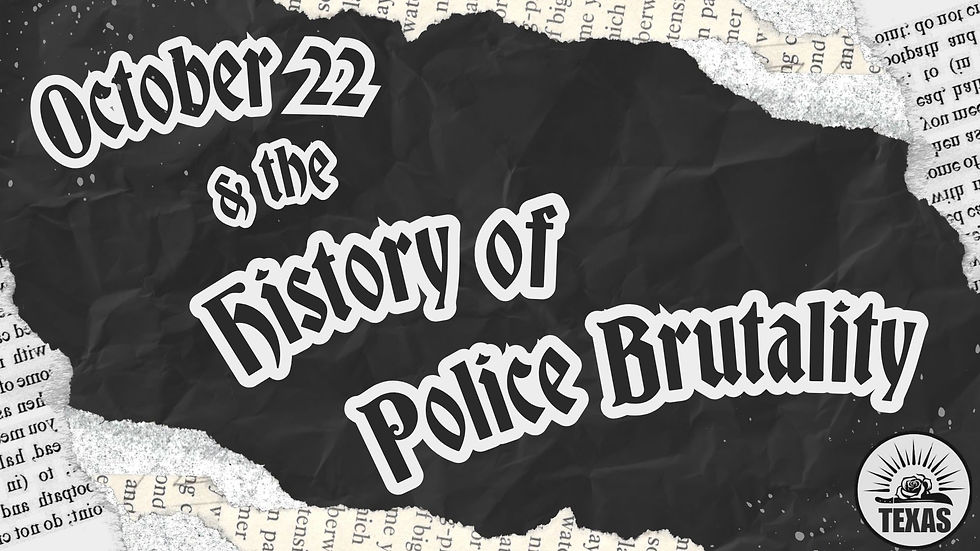
Could you share a bit on your decision to read "A History of Policing in the Rio Grande Valley? "We chose 'A History of Policing in the Rio Grande Valley' by Lupe Pardo in preparation for our actions on October 22nd, which is National Day of Protest Against Police Brutality. People are enraged with ICE violence and ready to take a stand, so this text will help our community understand how police and ICE oppression are connected. For example, Los Fresnos police sent Hilda Torres to the El Valle Detention Center to cover up a botched traffic stop, and Alamo police have refused to help Luis Ochoa after ICE agents assaulted him." This zine is the "tool" that starts the step - which then leads us to the action being O22. The way it's so planned out. There is intention and planning behind these readings especially tied back home, our own backyard.
These readings even be seen as calls for advocacy/a message/an action. How could the reader/participant engage past the reading once the monthly meeting has ended? "Talk to us after book club! We encourage people to stay connected and join us for mass work if the readings inspired them. You can also DM us on Instagram at @redstar_tx and @halftheskytx"

What readings would you personally recommend? Bonus points if we can access these online! "I recommend all our former readings, but I particularly like 'In It Together' by Interrupting Criminalization & Dragonfly Partners because it's about how to navigate conflict. People can know all the theory in the world, but knowing how to regulate our emotions and talk out differences are often lost skills, even though they're the most important ones. I also suggest 'Combat Liberalism' by Mao for the same reason because it's basically about how to be a good person. These lessons have greatly improved how I navigate my personal relationships and struggles, and in turn I'm better able to show up for my community. The best organizers I've ever known were also the kindest." Time for me to catch up on these missed out readings! Adding the links down below.
How do you wish to push forward with the Red Star Book Club? "I see the book club as a vehicle for teaching about mass work, and outside of it we will continue to provide opportunities to learn by doing. I'd like to see more guests go beyond advocacy and join us in talking to their neighbors, learning about their struggles, and uniting for real change."
Any final comments you'd like to make? "I've been hosting all the meetings and making all the flyers for a year now, but I also invite others who would like to help in these roles! Our meetings are often held in McAllen and always with a virtual option, and hopefully in the future we can host in other cities as well!"
Provided Reading Links:
Mass Work Guide - https://canva.link/6woisakd2ht7m13
Presentation on October 22nd and The History of Police Brutality - https://canva.link/l6lt9z82ytzihlu
Face The World, Brave The Storm - https://daretostruggle.org/2024/05/29/face-the-world-and-brave-the-storm-why-going-to-the-masses-is-a-strategic-necessity/


Comments